
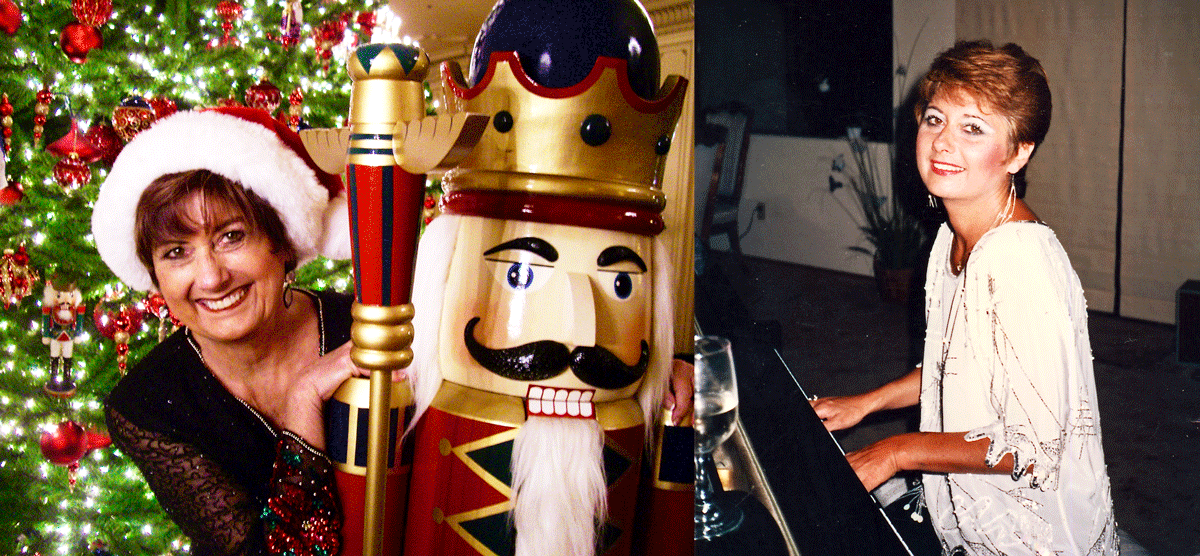
Karen Giorgio came into this world not with a silver spoon, but with a magic wand. Whenever she waved it, she entered a musical wonderland of her own.
The magic began on Christmas morning when Karen was six. Her father had secretly restored an old, white upright piano in the basement of their home in Yorktown Heights, New York, and presented it to her as a Christmas gift. But to Karen, it was the doorway to her life.
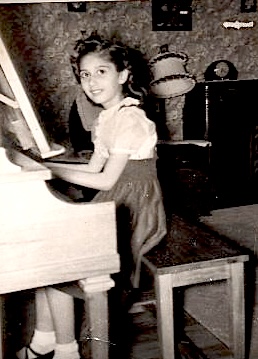 She had never played a piano before. But she could hear a song, sit down at the keyboard, and find the melody with her fingers. She would hum, then sing the words, imagining herself as Judy Garland.
Her first audience was Laddie, her beloved collie, who listened patiently as she sang her way through childhood.
Karen eventually took formal piano lessons, learning to read music, but playing by ear remained her prized talent. She could hear a song once and immediately play it back. That gift would stay with her throughout her musical career.
Her parents arranged formal singing and acting lessons in Manhattan. She developed a beautiful coloratura soprano voice and appeared as a guest soloist with several symphony orchestras in New York's Hudson Valley and Westchester County area.
But as much as she enjoyed classical music, popular songs stirred her heart the most. She loved songs that told stories, songs that let her become the person who lived the story.
At fourteen, her acting teacher introduced her to a Broadway summer-stock theatre company, which cast her as Francie, the lead character in the musical A Tree Grows in Brooklyn.
With her mother as chaperone, Karen spent two glorious summers touring the East Coast, singing, acting, and living the dream of a young girl who had found her place in the world.
Life was wonderful.
Then, when Karen was sixteen, a heart attack took her father away.
The man who had given her that first piano, and with it the keys to her musical wonderland, was gone.
It was a sad time. The energy disappeared. Life became more real.
The promises of a theatrical agent with grand plans for Karen soon seduced her mother into moving to California. Those promises never materialized, and life at home became increasingly difficult.
Karen threw herself into her music and acting studies at Hollywood High School. Her natural talent quickly earned her starring roles in
the school's Broadway productions and even an opportunity to perform as a soloist at the Hollywood Bowl.
But after graduation, without the guidance or opportunities she had hoped for, her musical ambitions gradually gave way to the practical demands of earning a living.
Just then, Morris came along, the saving knight.
Having grown up an only child, she always dreamed of a family of her own. Marriage offered the prospect of that cherished life. But after two miscarriages, she learned she could not bear a child.
Karen was not a woman who surrendered easily.
She persuaded Morris to adopt — “A girl for me, a boy for you."
Christina arrived first. Four years later, Morris got his boy.
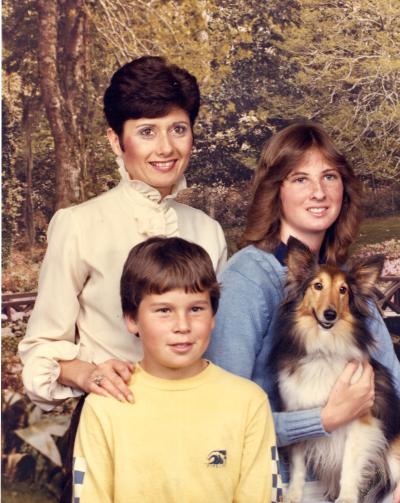 Karen Giorgio Jacobs became a devoted stay-at-home mother, embracing the joys, anxieties, and chaos of raising two children. Her music remained part of her life, but her family now occupied center stage.
Then, when the children were in their teens, Morris left.
Karen struggled with feelings of rejection and uncertainty about her future. Her music wouldn’t come. Her fingers wouldn’t move at the piano keys. The divorce devoured all of her. She sought professional help, and her therapist offered a suggestion that would change the course of her life.
"Go back to your music."
That command struck a hard note. It was as though someone had handed back her magic wand.
She began modestly, one evening agreeing to substitute for a pianist named Tiny at a rather seedy San Diego piano bar. Night after night, she played "Red Sails in the Sunset" for homesick Navy sailors and anyone else who cared to listen.
And gradually, she found her own sea legs.
The jobs improved, her confidence grew, and Karen realized that the musical career she had once imagined might not have disappeared after all.
It had simply been waiting for her.
At her friends’ urging, she invested her last dime in a professional photograph and demonstration tape. She even borrowed a dress for the occasion.
That became her magic carpet.
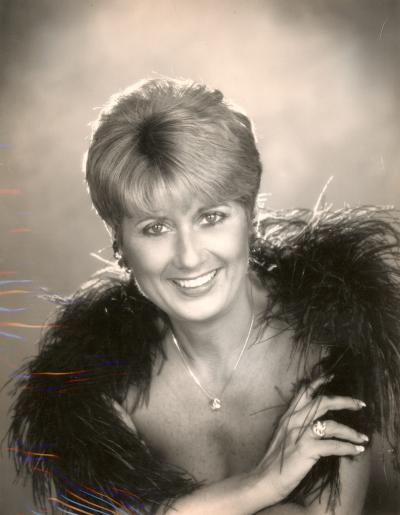 Having listened to the tape, an agent called.
“Would you be willing to travel to Saipan?”
She immediately replied, “YES!"
The glee was overwhelming. The details never registered. Finally, reality set in, and she turned to her friends. "Where is Saipan?"
Armed with an old suitcase, a borrowed gown, and a hastily obtained passport, Karen jumped onto her magic carpet and embarked on an international career that would show her the beauty of island palms and tropical fish of Saipan and the Pacific Islands, the murmur of foreign languages and sophistication of elegant hotels and lounges in Europe and Scandinavia, a wild, wintry time in Calgary, Canada, and the stages and lounges and excitement of numerous cruise ships.
She entertained in fine hotels and resorts, making friends and admirers wherever she went. Her repertoire seemed inexhaustible. She could summon a song from memory almost as quickly as someone could request it, and she had the rare ability to make an audience feel she was singing directly to each of them.
After years of traveling, Karen returned to San Diego and secured a coveted engagement at the Plaza Bar of the Westgate Hotel.
There, her life took another unexpected turn.
Every Friday evening, while Karen was performing at the Plaza Bar's baby grand piano, a man would enter the room pulling a small carry-on suitcase. His name was David Crellen, and he was returning home for the weekend from his work in Atlanta.
Karen would see him from across the room.
Even in the middle of a song, something about her would change. She would sit a little straighter. Her bright eyes would widen, and her ever-present smile would broaden as though someone had turned up the spotlight.
Then her fingers would find a new melody.
“You Are The Wind Beneath My Wings”
It became their private greeting.
Cupid, it seemed, had taken up residence at the Westgate.
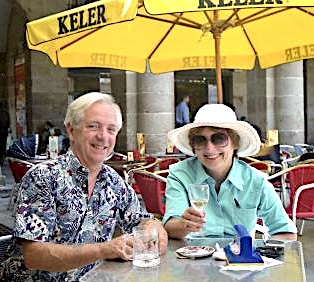 David eventually swept Karen away to Atlanta, a city with a rich musical heritage and new opportunities for her career.
Karen was no stranger to travel, but this time she wasn't traveling alone. With her magic carpet, she and David were beginning a new life together.
She kept entertaining and gradually discovered a rewarding audience: residents of retirement communities and nursing homes.
Karen had always loved the American Songbook, the Broadway melodies, the popular standards that had accompanied much of the twentieth century. Now she performed for people whose lives had unfolded alongside those very songs.
After her gigs, she would describe her feelings to David: “I love to watch the audience as they walk in. They look tired and sometimes sad. But when I play and sing songs they relate to, I see them tap their feet. They perk up and smile. Some of them even mouth the words. That is so rewarding. I made their day, and they made mine."
This connection made Karen's performances so special.
She did not simply sing the songs. She felt them. A wistful ballad brought a tear to her eye, while a cheerful Broadway number lit up her face — and the room. Her audience responded not only to her voice but also to the genuine emotions she shared.
And she remembered everything.
"Any requests?" she would ask.
Thousands of songs seemed to reside somewhere within her, each ready to emerge the moment someone called out a title. Her musical memory was faster than a jukebox and considerably more charming.
Eventually, Karen and David returned to San Diego, where she resumed her musical career without missing a beat.
But Karen still had another dream.
For years, she had wanted to produce and perform her own cabaret shows. Not simply to entertain an audience from behind a piano, but to take center stage and create an entire evening of music, stories, and the songs she loved.
So she did.
 She produced and performed several cabaret stage shows, bringing together her love of music, acting, and storytelling. Her first production carried a title that said everything there was to say about Karen's approach to life:
Cabaret My Way.
It was her show, her music, her stories, and her way of sharing them with an audience.
She had come a long way from that little girl sitting at her father's restored piano. But she was still the same girl, entering her musical wonderland and inviting everyone else to come along.
 Karen and David enjoyed a happy private life together, surrounded by friends and their beloved Brittany dogs. Music was never far away, whether Karen was performing professionally, entertaining friends, or simply sitting at her piano for the pleasure of playing.
Then, around the time of the COVID-19 pandemic, David began noticing subtle changes in Karen.
She would hesitate at the piano. She’d slip with a song’s words. The first signs of Alzheimer's disease had appeared.
Her ability to recall the music she loved faded. Then, with heartbreaking speed, the songs disappeared. The piano, her companion since childhood, could no longer bring them back.
It was as though someone had turned off the light in her musical wonderland.
And it never came back on. The carpet lost its magic.

David became her full-time caregiver, determined that she should remain in the comfort and familiarity of their home.
Through much of her illness, Karen retained her gentle disposition and her beautiful smile. Though the music had left her, she often appeared peaceful and content, smiling as though she remained, in some quiet corner of her mind, at peace with the world.
In early 2026, the effects of Alzheimer's accelerated. Karen became increasingly frail, and on August 28, 2026, she peacefully succumbed to the disease while in the arms of her loving husband, David, and daughter, Christina.
She had once described what music meant to her:
"When I'm entertaining, I'm in my own wonderful world. I relive every song I sing."
That was Karen's gift. She could enter a song and make it her own, then invite everyone listening to join her. For a little while, their troubles might be forgotten, an old memory might return, or an ordinary evening might become something wonderful.
Her life was not without sorrow. She lost her father too young, endured disappointments and heartbreak, and faced an illness that took away the music and memories she cherished.
But she also found love, raised the family she had dreamed of, traveled the world, and brought happiness to countless people who might otherwise have passed an evening in loneliness or silence.
The little girl who had sat at her father's restored piano had carried its music with her throughout her life.
And she had shared it generously.
Karen's life was a beautiful book, filled with love, adventure, music, and more than a few unexpected turns. Its final page has now been written, but the story remains with those who knew and loved her.
And somewhere, whenever an old familiar song brings a smile, a memory, or a tear to someone's eye, a little of Karen's magic will live again.

————
